Structural Drying and Dehumidification in White House, TN
A room can look dry while the framing behind it is not. The drying team removes water from studs, subfloor and wall cavities, then backs it up with daily readings against a dry sample.
(888) 849-5796Start the drying now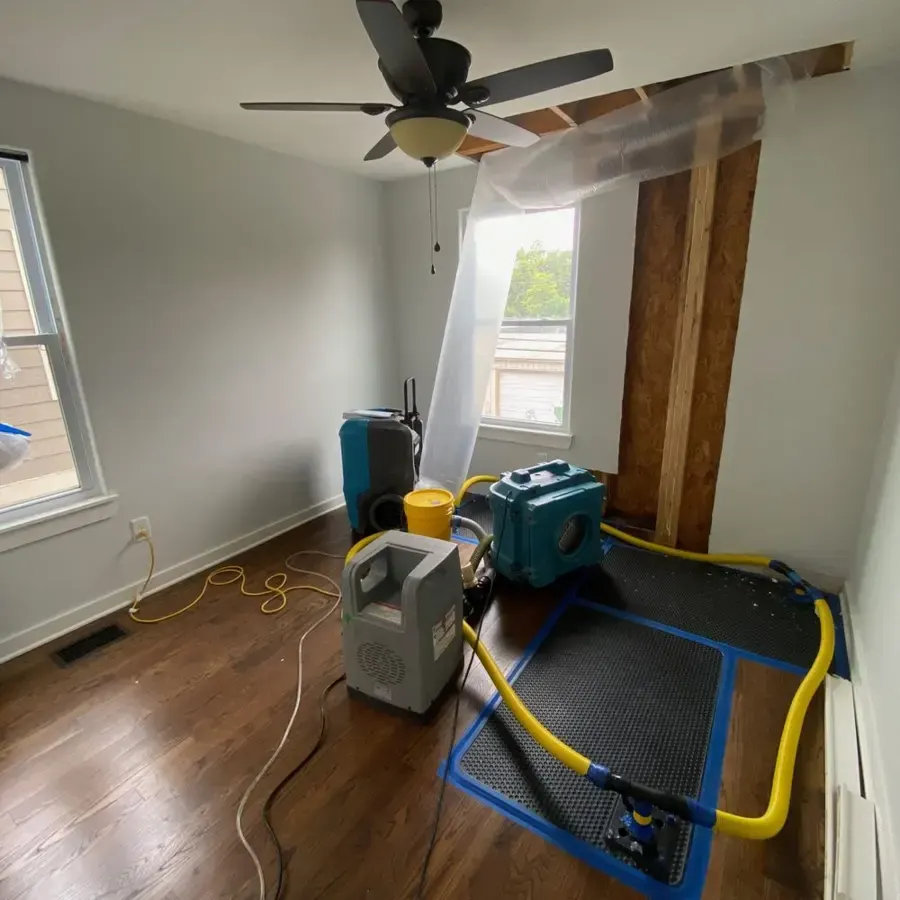
In White House the drying phase follows every kind of water loss, from a flooded garage after the February 2025 storms to a failed supply pipe in a newer frame home. Wet drywall, subfloor and framing do not dry on their own while a house sits closed in humid weather, so the drying team brings in equipment and measures progress.
First steps for structural drying and dehumidification in White House
- 1
Close up the house
Muggy outdoor air undoes the work, so keep windows and exterior doors shut.
- 2
Let the machines run
Shutting them off overnight lets moisture settle back into the materials.
- 3
Leave doors where they are
The crew sets each door open or closed to steer airflow.
- 4
Mention fresh odors or marks
They may reveal a wet spot nobody found.
What does structural drying and dehumidification cost in White House, TN?
In White House, structural drying typically costs $1,000 to $8,000. Class of loss, room and level count, dense materials like hardwood or plaster and the length of the equipment run drive the figure.
Light loss, a single area
$1,000 to $2,500- Fans placed
- One dehumidifier
- Daily meter notes
Class 3 across several rooms
$2,500 to $5,000- Walls and ceilings
- Several dehumidifiers
- Mapped wet zones
Dense materials, Class 4
$5,000 to $8,000- Desiccant unit
- Floor mats
- Extended checks
Ranges are typical, not a quote: category of water, square footage, material class and how fast drying started move the number most. Run the water damage cost calculator for a closer range.
How structural drying and dehumidification is handled in White House
The tech who does the walkthrough maps moisture before any equipment goes down, so the drying plan matches what is actually wet. Equipment stays until the readings say dry, not until it looks dry.
- 1
Rate the loss
Category and class decide the plan and how much gear goes in.
- 2
Place the gear
Fans, dehumidifiers and mats are set room by room.
- 3
Measure each day
Air and material readings are written down every visit.
- 4
Release the gear
Machines are removed when readings agree with the dry sample.
How the class of loss sets the gear
Losses are sorted into four classes by how much water the materials absorbed. A Class 1 loss is a small patch with little wicking, while Class 4 involves dense stuff like hardwood, plaster or concrete that stores water deeply. That sorting tells the team how many air movers each room needs and which dehumidifier suits it.
- Air movers sized to each room's evaporation load.
- LGR units for most jobs, desiccants for the densest materials.
- Mats pulling water from hardwood, with crawl space water damage covering wood dried from below.
How the goal is proven
A reading is taken on the same material in a dry part of the house, and that becomes the reference. Wet materials are measured daily, and equipment leaves only once they sit 2 to 4 points from it. Those numbers are the proof an adjuster looks for.
- Air temperature, humidity and moisture content logged each day.
- Wood and drywall readings marked on the map of the loss.
- Machines relocated when rooms finish at different rates.
Why rebuilding waits
Walls closed over damp framing hold moisture behind fresh drywall and flooring. For a rough timeline, the drying time estimator is a decent starting point.
Structural drying and dehumidification across White House and nearby towns
The drying team works ZIP 37188 across Sumner County and Robertson County, from Bridle Creek, Cedar Brook and Covington Bend to Dorris Farms, Sage Farms and Palmers Chapel Road.
The same service nearby: structural drying and dehumidification in Gallatin, Millersville, Hendersonville.
Water damage restoration in White House · every town covered
Related water damage services in White House
Structural Drying and Dehumidification questions in White House, TN
Are box fans enough?
Fans alone only move damp air, and with no dehumidifier the moisture settles into walls and floors again.
What counts as dry?
Wet material is measured with the same meter used on a dry sample. The job is done once the two numbers are 2 to 4 points apart.
Why so much noise?
Moving that much air across wet surfaces is what speeds evaporation, and the racket stops when the machines do.
Is hardwood savable?
Often, if mats and steady dehumidification start quickly.
How many days will it run?
A small, contained loss often takes three to five days, while dense materials need more.
Does my power bill rise?
Yes, the machines draw from the house's electricity. Certain insurers repay the extra cost, so ask about it.
Start the White House dry-out.
Proof of a finished dry-out comes from readings, not hunches. The drying team records every day until the framing is dry.
(888) 849-5796Begin structural drying- 24/7 dispatch for active water
- Dried to the IICRC S500 standard
- Daily readings for the claim file
- Find us on Google