Water Extraction and Removal in White House, TN
Standing water in a garage or on a finished floor keeps climbing into drywall and subfloor. The extraction crew pulls it out as liquid first, so the dryers have far less moisture left to handle.
(888) 849-5796Drain the standing water now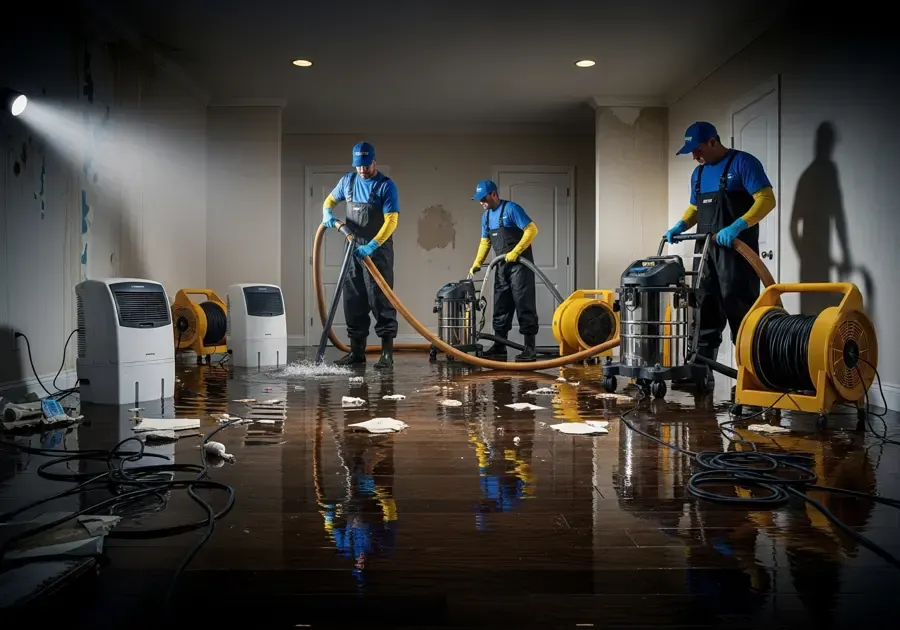
Most White House homes were built recently, and about 4,480 are single-family detached houses. Many have a garage that can take on street runoff, as several subdivisions found in February 2025 and June 2026. Pulling water out as liquid is the first move, because it is far quicker than letting it evaporate.
First steps for water extraction and removal in White House
- 1
Stop the supply
If water is still running, turn off the main or the fixture shutoff.
- 2
Stay clear of outlets
Do not wade through water near cords, outlets or plugged-in appliances.
- 3
Lift valuables up
Raise rugs, electronics and papers onto dry, higher surfaces.
- 4
Leave the upright vacuum alone
Only a shop vac belongs near water, and only for small spills.
What does water extraction and removal cost in White House, TN?
In White House, water extraction usually runs $800 to $5,500. The category of water, the square footage, the flooring and whether it reached more than one level or an under-floor space all move the figure.
One room, clean water
$800 to $1,800- Truck-mounted pull
- Wet-area sketch
- Starter fans
Several rooms or a level
$1,800 to $3,500- Pad and carpet decisions
- Baseboards pulled
- Dehumidifiers set
Gray or contaminated water
$3,500 to $5,500- Hazard protocol
- Pad tear-out
- Antimicrobial spray
Ranges are typical, not a quote: category of water, square footage, material class and how fast drying started move the number most. Run the water damage cost calculator for a closer range.
How water extraction and removal is handled in White House
The tech who does the walkthrough maps moisture before any equipment goes down, so the drying plan matches what is actually wet. Equipment stays until the readings say dry, not until it looks dry.
- 1
Confirm it is safe
The crew checks that the source is off and power is safe nearby.
- 2
Pull the bulk
Truck units and pumps remove the standing water.
- 3
Map what remains
A thermal camera and meters trace each damp surface.
- 4
Set the dryers
Fans and desiccant or LGR units get matched to each room's load.
What gets extracted
Truck-mounted units pull water from carpet and pad, from garage slabs and from low spots in a living room. Weighted tools press out the water that a shop vacuum leaves in a rug. Submersible pumps handle depth before anyone starts on the finish floor.
- Carpet and pad get extracted first, then judged for drying where they lie or removal.
- Wood, tile and plank flooring: seams are drained and the subfloor is checked.
- Flooded garages and low rooms: pumped first, with storm and creek flood cleanup for runoff.
Finding the wet that you cannot see
Water creeps beneath baseboards and up into the bottoms of walls. On the walkthrough the tech sweeps meters and a thermal camera over the area, so the drying plan reaches hidden damp spots and not only the puddle.
- A first-visit sketch marks each wet material.
- Toe kicks and trim come off wherever a cavity reads wet.
- Pictures of each wet area are taken ahead of any removal.
Safety before the pumps start
Stay away from standing water near cords and outlets, and cut power to wet rooms only from a dry panel. Once the extraction is done, structural drying finishes the job by pulling out what the wands could not reach.
Water extraction and removal across White House and nearby towns
Extraction crews work ZIP 37188 in Sumner County and Robertson County, covering The Parks, Legacy Farms, Sage Farms and Dorris Farms as well as Calista Road and Sage Road.
The same service nearby: water extraction and removal in Gallatin, Millersville, Hendersonville.
Water damage restoration in White House · every town covered
Related water damage services in White House
Water Extraction and Removal questions in White House, TN
Will a shop vac do the job?
A small clean spill, maybe. Once water has soaked pad, reached a wall or pooled in a garage corner, a shop vac leaves most of it behind.
Can the carpet be kept?
Carpet hit by clean water and dealt with quickly often stays. If the water was gray or black, the pad and frequently the carpet go.
How long will extraction last?
A single room often needs an hour or two of pulling. Large losses and flooded garages run longer, and the drying phase continues for days.
Why take off baseboards?
Water collects in the cavity behind them. Opening it lets that space dry rather than hold the moisture.
Do I have to move out?
Not for most clean-water losses. Sewage or runoff may call for keeping the affected rooms closed.
What comes after extraction?
Fans and dehumidifiers keep running while meters follow each wet material down to the drying goal.
Standing water in White House? Call now.
Water pulled out today is water that never needs drying out of a wall tomorrow.
(888) 849-5796Get the water out now- 24/7 dispatch for active water
- Dried to the IICRC S500 standard
- Daily readings for the claim file
- Find us on Google