On March 27 and 28, 2021, flash flooding put up to three feet of water in Valley Center businesses and a church in Mount Juliet. The wall board that was later replaced went up to 4 feet from the floor, higher than the water itself had stood.
Key takeaways
- Drywall pulls water upward, so the damaged section of wall is taller than the high water mark.
- After the March 2021 flood, Valley Center businesses replaced wall board up to 4 feet from the floor and replaced flooring.
- Floodwater from a creek or ditch is Category 3, so porous finishes are removed.
- The business owner should photograph the high water mark, the stock and the equipment before anything moves.
- A fast dry out shortens the time a shop or restaurant stays closed.
What happened at Valley Center in March 2021
Valley Center is a commercial center in Mount Juliet with restaurants and other storefronts. During the March 27 and 28, 2021 flash flooding, water rose to as much as three feet inside businesses and a church.
Mount Juliet is known as the City Between the Lakes, and creeks and detention ditches in town can overflow when heavy rain stacks up.
For a business owner, a flood like that turns a normal workday into a closure, with stock, equipment and finishes all at risk.
Wall board in that flood was replaced up to 4 feet from the floor, and flooring was replaced too. Those repairs show the scope that a three foot flood can create.
Why the wall damage reaches higher than the water
Drywall is paper and gypsum, and it acts like a wick. When the bottom of a wall sits in water, moisture climbs the board above the high water mark.
That is why the replacement work after the flood went up to 4 feet from the floor, even though the water was reported at up to three feet.
Behind the wall board, insulation and the bottom plate of the wall frame can also take on water and stay wet long after the surface looks dry.
- Drywall: pulls water up above the visible high water mark.
- Insulation: sags and holds water inside the wall cavity.
- Baseboard and trim: swell and trap moisture behind them.
- Framing: the bottom plate and studs dry slowly because they are enclosed.
The first day for a business owner
A shop or restaurant has more to protect than a house does. The first day is about safety, documentation and stopping more loss.
The aim of the first day is to stop the loss from growing. Every hour that wet drywall and flooring stay in place adds to the final repair list.
Safety and documentation
Do not enter if electricity may be live in standing water. Shut off power at the panel only if it can be done from a dry spot.
Photograph the high water mark, the damaged stock and the equipment. A clear record helps with the insurance claim and shows what was lost.
Protecting what can be saved
Move dry stock and paperwork out of the affected area.
Leave flooded appliances and kitchen equipment where they are until they are checked, and do not turn them on.
How the dry out is done
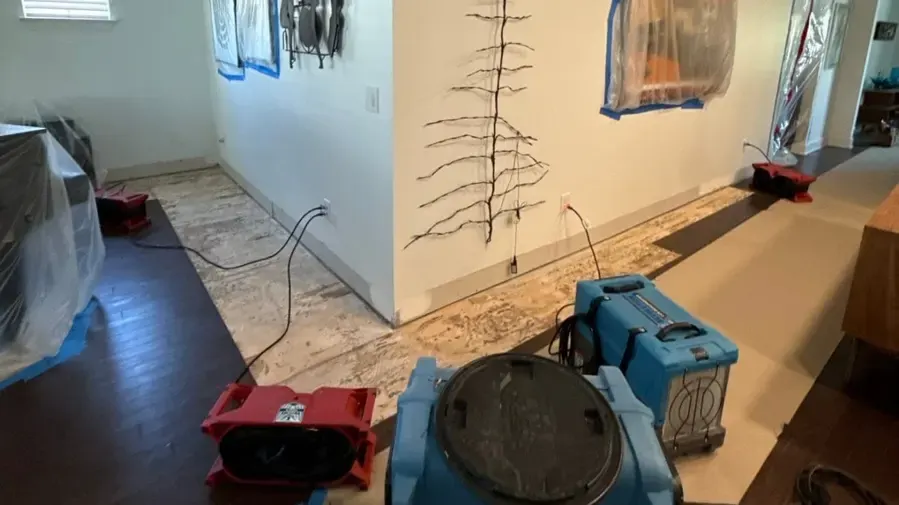
The extraction crew removes the standing water first. After that, wet flooring and wall board that touched floodwater are cut out, because they cannot be cleaned.
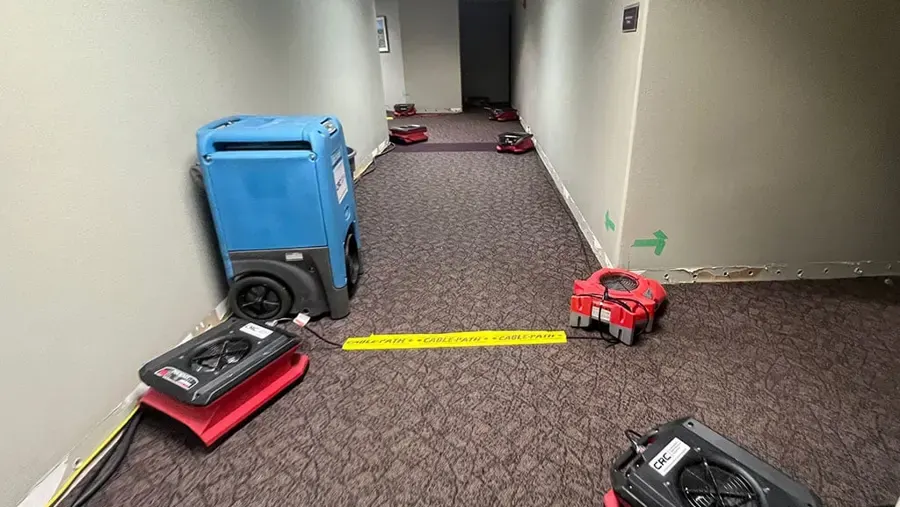
The drying team then sets air movers and dehumidifiers in the dining room, sales floor or back of house, and takes moisture readings in the remaining wall framing and the slab.
A restaurant or shop needs the readings to reach the target before new wall board and flooring go in. Closing a wall too early traps moisture and leads to repeat problems.
In a restaurant, hoods, walk in coolers and kitchen equipment may need separate checks by their own service companies. The dry out covers the building, not the appliances.
Customers and staff do not use the space until it is safe. A written plan for when each area reopens helps a business get back to work in stages.
- Extraction of standing water.
- Removal of wet wall board, insulation and flooring.
- Cleaning and antimicrobial on surfaces that stay.
- Drying with air movers and dehumidifiers, checked with a meter.
What a tenant, owner or church should ask
Valley Center businesses and a church were hit in 2021, and the questions that came up apply to any commercial building. Ownership and lease terms decide who handles which part of the work.
A tenant often has responsibility for stock and fixtures, while the owner handles the walls and floors. Knowing that split before a flood saves time later.
- Who is responsible for the walls, flooring and mechanical equipment?
- What does the policy cover, and is there a flood endorsement?
- How is lost income handled while the space is closed?
- Who keeps the records of damage and repairs?
Getting ready for the next heavy rain
Mount Juliet created a stormwater utility and fee program in November 2022 to deal with long standing flooding and aging stormwater infrastructure. That is a public project, and it does not remove the need for a business plan.
A simple plan helps any storefront or retail center, including those in places like Providence Marketplace.
Where the building has valuable stock, keeping it up off the floor and keeping a contact for restoration on hand saves valuable time.
- Keep stock and paper records up off the floor.
- Know where the main electrical panel is and how to reach it safely.
- Keep a photo record of the space in normal condition.
Where to read more
The full service is described on the commercial water damage in Mount Juliet page, and the drying approach is laid out under structural drying.
The Mount Juliet hub lists every service available in town, and commercial water damage in Gallatin shows how it works for businesses in the main city.
Questions
Why do contractors cut the wall higher than the high water mark?
Drywall wicks moisture upward. The wet area is usually taller than the visible high water mark, and that part has to be removed.
Can drywall that got wet from floodwater be dried and kept?
Usually not. Floodwater is Category 3, so wet porous drywall and insulation are normally removed.
How high did water get in Valley Center in 2021?
Reports put up to three feet of water in Valley Center businesses on March 27 and 28, 2021. Wall board was later replaced up to 4 feet from the floor.
What should a business owner photograph first?
Take photos of the high water mark on the walls, the damaged stock and equipment, and the floors, before anything is moved or thrown out.
Is it safe to turn on equipment that got wet?
No. Flooded appliances and kitchen equipment should be left off until they have been checked and dried.