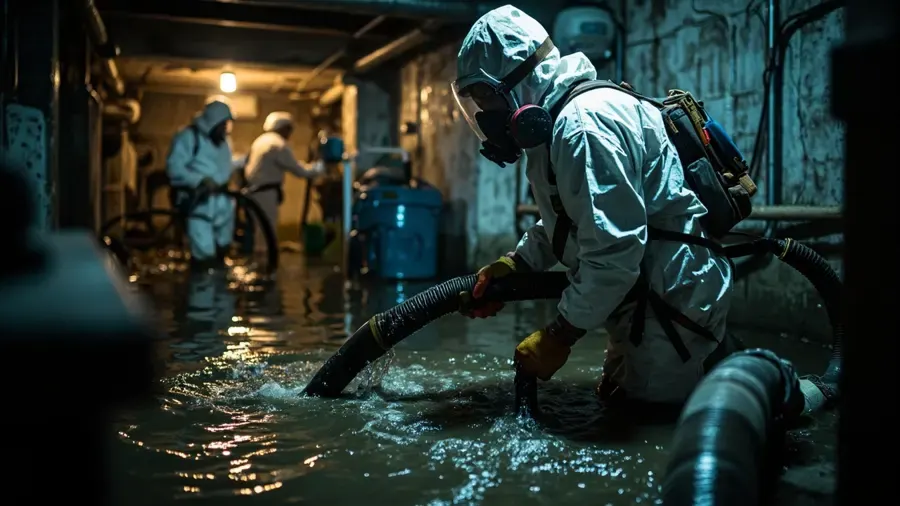
Roughly half of White House homes and businesses connect to the city sewer through a grinder pump or a vacuum valve pit. When one of those fails or backs up, sewage ends up inside the house.
Key takeaways
- A sewage backup is Category 3 water, so the first priority is keeping people and pets out of the area.
- The City of White House maintains the grinder pump or vacuum equipment for over 99 percent of those connections.
- Wet porous materials such as carpet, pad and drywall that touched sewage are removed, not dried.
- Hard surfaces and framing are cleaned and treated with an antimicrobial, then dried and read with a meter.
- The homeowner should document the damage with photos before cleanup starts.
How White House sewer connections work
White House runs a publicly owned wastewater system that includes more than 40 pump stations and roughly 3,000 grinder pumps. Homes use either a grinder pump or a vacuum valve pit to send waste into the system.
A new wastewater treatment plant began operating in 2024, after construction started in 2021, and treated water is discharged into Frey Branch.
The city maintains the grinder pump or vacuum equipment for over 99 percent of the connections that use them.
White House also has vacuum valve pits, which use suction to move waste instead of a pump at each house. Either way, the equipment sits at the edge of the property and ties the house to the city system.
What a backup looks like in a house
A backup does not always start with an obvious overflow. It can begin slowly, so it helps to know the early signs.
The lowest drain in the house usually shows a backup first, so a floor drain or a ground level shower is where it often appears.
- Slow drains: sinks, tubs and showers that drain more slowly than usual.
- Gurgling: air noises from a toilet or floor drain when water runs elsewhere.
- Odor: a sewer smell in a bathroom, laundry room or garage.
- Water at the lowest drain: dark water rising in a shower, tub or floor drain.
When the pump is the problem
If a grinder pump stops working, waste has nowhere to go and can come back up through the lowest fixtures in the house.
That is the time to stop using water, because every flush or load of laundry adds to the backup.
Why sewage is treated as Category 3
Category 3 is the most contaminated class of water. Sewage can carry bacteria and other contaminants, so it is never handled as ordinary water damage.
That classification drives the work plan. Anything porous that sat in sewage, such as carpet, pad, upholstery and drywall, is bagged and removed because cleaning cannot make it safe.
The risk is greatest for children, older adults and anyone with a weak immune system, so the area should be closed off until the cleanup is complete.
Category 1 water comes from a clean source such as a supply pipe, and Category 2 is used water such as a washer discharge. Category 3 includes sewage and floodwater, which is why the steps are stricter.
What to do before anyone arrives
Some steps help and some make it worse.
Keep a short written record of what happened, in order. The record helps both the city and the restoration team understand the cause.
- Stop using water: no flushing, laundry or dishwasher until the backup is dealt with.
- Keep people and pets out: children and animals should stay out of the room.
- Do not use a household vacuum on sewage, since it spreads contamination.
- Take photos of the backup and the damaged items before anything is moved.
- Contact the City of White House Wastewater Department, since the city maintains the grinder pump or vacuum equipment.
How the cleanup runs
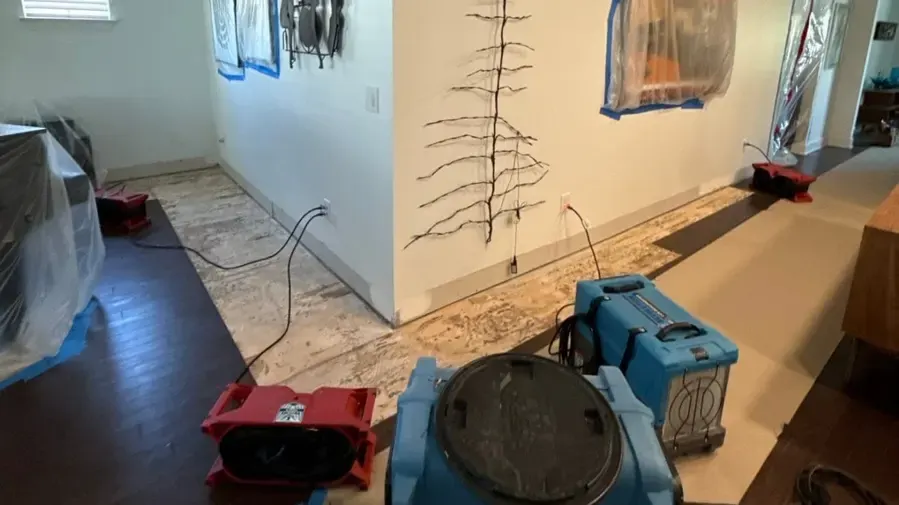
The restoration team begins by containing the area with plastic sheeting so contamination does not spread to clean rooms. Protective gear is worn throughout.
Standing sewage is extracted, and then the removal begins. Soaked flooring, pad and the lower part of walls that touched sewage come out.
Remaining hard surfaces and framing are cleaned and treated with an antimicrobial. Then the space is dried with air movers and dehumidifiers until moisture readings reach the target.
The work is checked with a moisture meter at the end, and the contaminated materials leave the house in sealed bags.
- Containment first, so rooms stay separate.
- Extraction of standing sewage.
- Removal of porous materials.
- Antimicrobial on cleaned surfaces.
- Drying checked with a moisture meter.
Grinder pump alarms and what they mean
Many grinder pumps have an alarm panel or a light that signals a problem. A flashing light or a sounding alarm is a warning that the pump is not moving waste as it should.
Heavy rain and power outages can also affect pumps and pump stations. When the power is out, an electric pump cannot run, and waste can back up into the house.
The City of White House Public Works and Wastewater Department handle the public system, so a homeowner with a pump alarm contacts the city before doing anything else.
Keep the area around the pump clear and do not bury the cover. Only the city or its crew should open or repair pump equipment.
- A light or alarm that stays on or flashes.
- A pump that runs without stopping or never seems to run.
- Water use that suddenly causes slow drains.
- Power outages that last long enough to stop the pump.
Insurance and where to read more
Backups can be caused by a pump failure, a blocked drain or a strained system after heavy rain. In White House, flooding in February 2025 and on June 9, 2026 put standing water in yards, garages and streets, which shows how fast wet weather can overwhelm drainage.
Sewer backup coverage varies by policy, and some policies need an added rider for it. The written scope and photos help the adjuster see what was removed and why.
The full service is described on the sewage backup cleanup in White House page, and the White House hub lists every service available in town.
The same general process also applies in other areas; the sewage backup cleanup in Gallatin page shows how the work is described for the main city.
Questions
Is a sewage backup dangerous to clean up myself?
Yes. Sewage is Category 3 water and can carry harmful contaminants. It is safer to keep out of the area and have trained crews handle it.
Who maintains the grinder pump in White House?
The city maintains the grinder pump or vacuum equipment for over 99 percent of the connections that use it.
Can carpet that touched sewage be cleaned?
No. Carpet, pad and other porous materials that touched sewage are removed because they cannot be made safe by cleaning.
What should I stop doing when sewage backs up?
Stop using water. Flushing, laundry and the dishwasher all send more water into the system and add to the backup.
Does homeowners insurance cover sewage backup?
It depends on the policy, and many need a separate rider. Photos and a written scope help when talking with the insurer.